
What is epigenesis and preformation?
By John Campbell
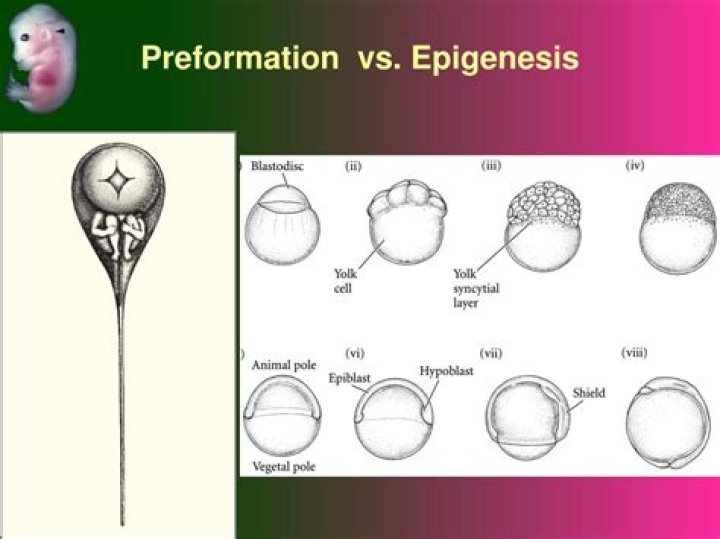
Where preformation stated that the germ cells of each organism contain preformed miniature adults that unfold during development, epigenesis held that the embryo forms by successive gradual exchanges in an amorphous zygote.
What do you mean by epigenesis?
Definition of epigenesis1 : development of a plant or animal from an egg or spore through a series of processes in which unorganized cell masses differentiate into organs and organ systems also : the theory that plant and animal development proceeds in this way — compare preformation sense 2.
What is the preformation theory in biology?
Preformationism was a theory of embryological development used in the late seventeenth through the late eighteenth centuries. This theory held that the generation of offspring occurs as a result of an unfolding and growth of preformed parts.Who proposed the theory of preformation?
10The first authors to formulate a preformationist hypothesis were Hippocrates, who proposed that all the structure of the adult was present in the zygote, and Anaxagoras, who believed instead that all parts of the child were preformed in the paternal semen. The roots of epigenesis theory go back instead to Aristotle3.What is the epigenesis theory of heredity?
Wolff (1734- 1794), which he proposed to counter the preformation- ist theory: epigenesis theory claimed that structures arise during development that are not already (pre-) formed (Wolff 1759, 1764).PCB 4253 Chapter 1 - Epigenesis & Preformation
Who gave epigenesis theory?
Aristotle (384–322 BC) is often seen as the first philosopher who defined epigenesis, despite the fact that the term does not appear at all in his work.What is an example of epigenesis in psychology?
Identical twins are the perfect example of epigenetics. Although they share exactly the same DNA, their unique experiences in life will cause some genes (and not others) to express themselves. This is why, over time, identical twins come to look and behave differently. [Who disproved preformation?
These two approaches were popular at their time, and reflected similarities with the psychology nurture vs nature debate. The preformationist model was ultimately disproven by cell theory, the division of cells involved in development and growth.What is preformation and homunculus?
In the history of embryology, the homunculus was part of the Enlightenment-era theory of generation called preformationism. The homunculus was the fully formed individual that existed within the germ cell of one of its parents prior to fertilization and would grow in size during gestation until ready to be born.Why do most scientists abandon the theory of preformation?
Preformationism, especially ovism, was the dominant theory of generation during the 18th century. It competed with spontaneous generation and epigenesis, but those two theories were often rejected on the grounds that inert matter could not produce life without God's intervention.What are 3 factors that affect epigenetics?
Several lifestyle factors have been identified that might modify epigenetic patterns, such as diet, obesity, physical activity, tobacco smoking, alcohol consumption, environmental pollutants, psychological stress, and working on night shifts.What is the difference between genetics and epigenetics?
Genetics and epigenetics are two types of studies of genes. The main difference between genetics and epigenetics is that genetics is the study of genes that control the functions of the body whereas epigenetics is the study of inheritable changes of the organisms caused by the modification of gene expression.Is epigenesis accepted?
Although this epigenetic process is now accepted as characterizing the general nature of development in both plants and animals, many questions remain to be solved.What is the purpose of a homunculus?
A motor homunculus represents a map of brain areas dedicated to motor processing for different anatomical divisions of the body. The primary motor cortex is located in the precentral gyrus, and handles signals coming from the premotor area of the frontal lobes.What is a homunculus in psychology?
homunculi) 1. a putative process or entity in the mind or the nervous system whose operations are invoked to explain some aspect of human behavior or experience.What makes a homunculus?
A Homunculus (meaning little man) is said to be a humanoid creature that is a fully formed microscopic human adult that is formed when sperm is injected into a chicken's egg. The creature comes from the concept of 16th century alchemy, it is historically referred to as creation of a miniature, fully formed human.When was the preformation theory discovered?
In the two millennia between the lives of Aristotle and Mendel, few new ideas were recorded on the nature of heredity. In the 17th and 18th centuries the idea of preformation was introduced.What are some examples of epigenetics?
Examples of epigeneticsEpigenetic changes alter the physical structure of DNA. One example of an epigenetic change is DNA methylation — the addition of a methyl group, or a "chemical cap," to part of the DNA molecule, which prevents certain genes from being expressed. Another example is histone modification.