
What is VAT and GST?
By Ava Hudson
Indirect tax general information
VAT (Value Added Tax) and GST (Goods and Services Tax) are non-U.S. consumption taxes imposed on sales of goods by businesses at each stage of production and distribution.Whats VAT means?
Value-Added Tax (VAT) is a tax, which is payable on sales of goods or services within the territory of the Member States of the EU. The tax, in all cases, is ultimately payable by the final consumer of the good or service.What is a VAT or GST number?
This number is an alphanumeric identifier unique to the person or entity doing business. A VAT or GST number is used to identify the tax status of a customer and also to identify the place of taxation.Is VAT a part of GST?
The rise of GST has subsumed all the indirect taxes in India, including Value Added Tax (VAT), Service tax, Excise duty, and Octroi.What is VAT example?
VAT= Output Tax – Input TaxFor instance, a dealer purchases goods of Rs 100 and pays a 10% VAT (Rs 10) on the same. You then purchase the goods at Rs 150 from the dealer, and s/he collects 10% VAT (Rs 15) from you. Here, the output tax is Rs 15 and the input tax is Rs 10.
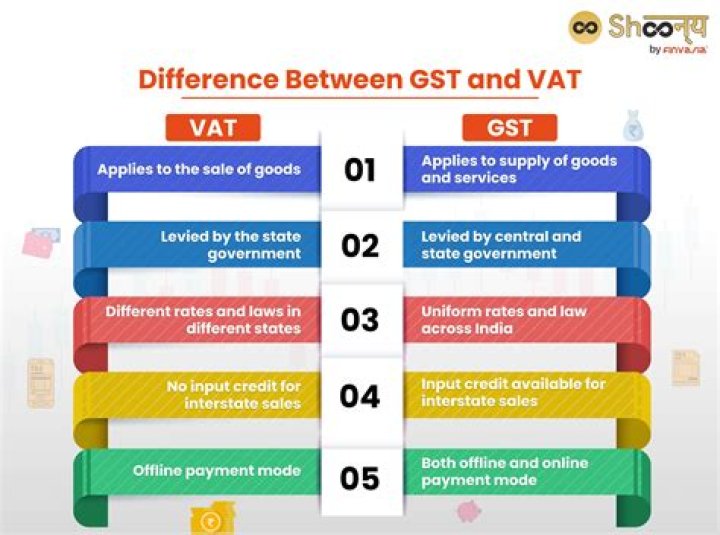
VAT vs GST - All You Need To Know
What are the 3 types of VAT?
There are three categories of supplies that can be made by a VAT vendor: standard-rated, zero-rated and exempt supplies.Is VAT same as tax?
Are VAT and Sales Tax the Same? VAT rates and sales tax are different because they are assessed at different points in the production process. VAT is paid on purchases by manufacturers, wholesalers, and retailers, so it's ultimately not recovered by consumers. Sales tax is only paid by the consumer.Is there VAT in India?
As of 2 June 2014, VAT has been implemented in all the states and union territories of India except Pondicherry, Andaman and Nicobar Islands and Lakshadweep Island.Who is paying VAT?
A value-added tax (VAT) is paid at every stage of a product's production from the sale of the raw materials to its final purchase by a consumer. Each assessment is used to reimburse the previous buyer in the chain. So, the tax is ultimately paid by the consumer.How do we calculate VAT?
Determine the tax, in the form of Value-Added Tax (VAT), and the Vatable Sales.
...
Here's how:
- Vatable Sales = Total Sales/ 1.12.
- VAT = Vatable Sales x 1.12.
- Total Sales = Vatable Sales + VAT.
Why do I pay VAT?
VAT is Value Added Tax. It is a sales tax charged by VAT registered traders on the value of the goods or services supplied to their customers. As explained below, the law requires UK traders with sales (turnover) above the VAT threshold to register for VAT and charge it on supplies of goods or services.How much percentage is VAT in India?
VAT is a globally accepted tax system. The guidelines laid down by the Government vary from one country to another. For example, the VAT rate in India is 12.36% whereas the UK vat rate is 20%. Generally, the countries that follow VAT system require their businesses to be registered.What are the 4 types of tax?
Digressive Tax.
- Tax Type # 1. Progressive Tax:
- Tax Type # 2. Proportional Tax:
- Tax Type # 3. Regressive Tax:
- Tax Type # 4. Digressive Tax: